Marketing does not fail from a lack of data. It fails from a lack of clarity. Most brands operate with fragmented tracking, misaligned attribution, and metrics that do not reflect actual revenue impact. We build analytics systems around accurate collection, structured reporting, and revenue visibility. Tracking becomes a decision-making system, not just a reporting layer.





Trusted by 60+ growth-stage brands
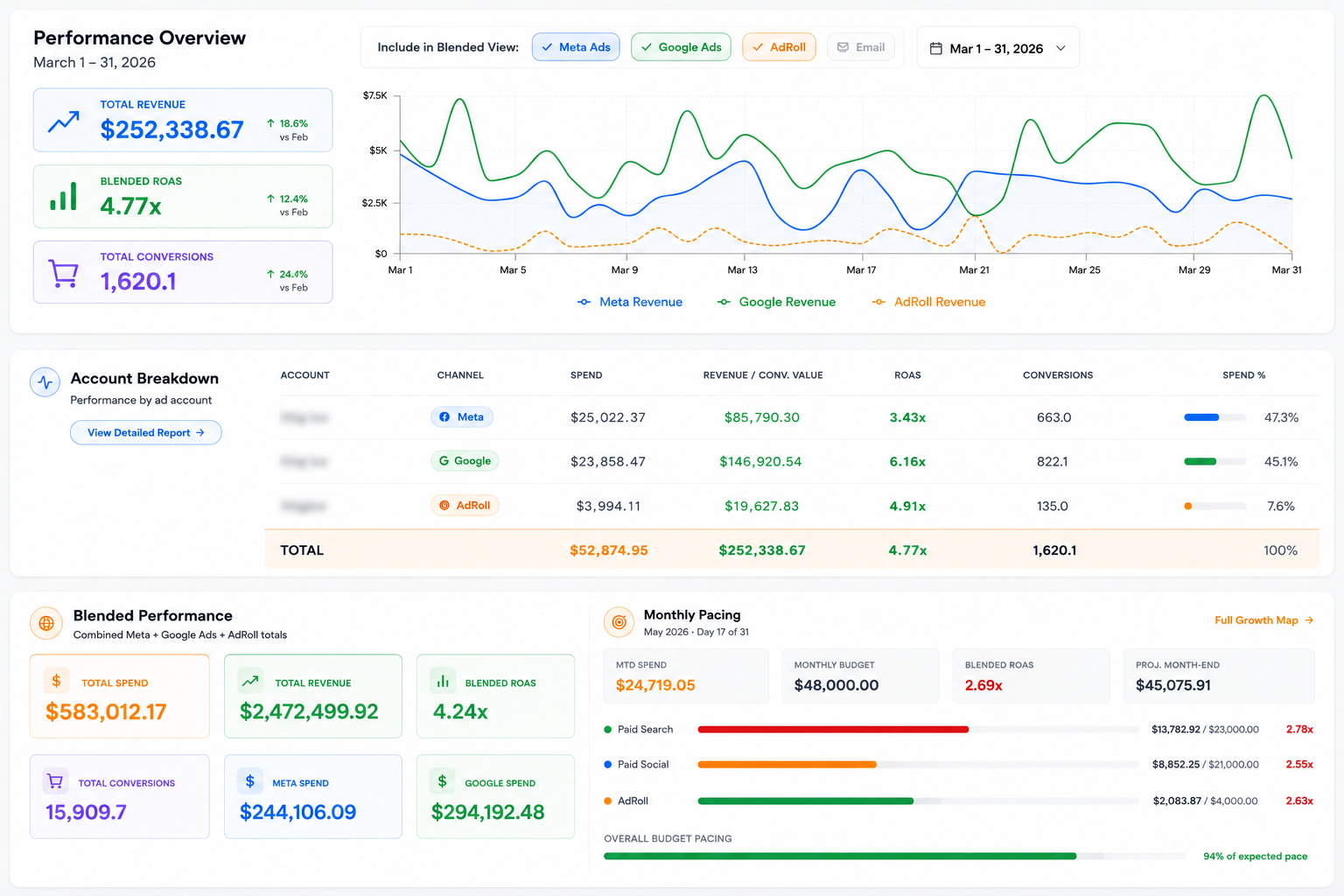
Effective measurement requires more than dashboards. We build a complete analytics infrastructure designed for accuracy, clarity, and actionable insight. We collect, validate, and structure data across platforms, then translate it into insights tied directly to performance and profitability. Every metric is aligned with business outcomes, not vanity indicators.






Reliable analytics depend on clean and consistent tracking. We configure event tracking, attribution models, and conversion goals for accuracy across platforms. Advertising systems, analytics tools, and backend data are aligned to eliminate discrepancies. Structured validation prevents duplicate events, missing conversions, and misattributed revenue. Clean data ensures optimization decisions are based on accurate signals.
Start with a Free Audit →Data becomes valuable when it is interpreted correctly. We consolidate performance metrics into structured reporting that highlights acquisition efficiency, conversion trends, and revenue contribution. Instead of focusing on engagement metrics, we prioritize indicators tied to profitability. Insights are delivered with clear recommendations to support better decisions in budget allocation, testing, and growth strategy.
Full review of pixels, tags, event firing, server-side setup, and platform integrations. We find every gap, duplicate, and broken signal before building anything new.
Define the events and conversion actions that reflect real revenue impact. Each event is mapped to a business outcome, not just an interaction.
Unified attribution model, dashboard architecture, and reporting infrastructure that connects acquisition spend to revenue across channels.
Ongoing QA, signal validation, and structured reporting that turns analytics into a decision-making system instead of a passive dashboard layer.
Not all traffic or campaigns contribute equally to growth.
We analyze acquisition channels, user behavior, and conversion impact to identify what drives measurable revenue. By connecting marketing inputs to financial outcomes, we clarify where to scale and where to optimize. This reduces wasted spend and improves capital efficiency.

Analytics systems provide structured visibility into acquisition performance, user behavior, and revenue contribution. Accurate tracking allows decisions to be based on measurable business outcomes instead of fragmented platform signals.
When data is disconnected across platforms, attribution becomes inconsistent and performance signals become unreliable. This creates uncertainty in optimization, budgeting, and scaling decisions.
Our process includes event tracking setup, conversion goal configuration, attribution alignment, reporting infrastructure, and validation across analytics and advertising platforms. Each component is structured to ensure data accuracy and clarity.
We validate tracking events, attribution models, conversion mapping, and platform integrations to eliminate discrepancies and missing data. Structured testing ensures analytics reflect real user behavior and revenue activity.
We prioritize metrics tied to profitability and acquisition efficiency, including revenue contribution, conversion behavior, blended acquisition cost, and revenue per visitor. These metrics provide clearer insight into growth performance.
We analyze channel-level acquisition data, user behavior patterns, conversion quality, and revenue contribution within a unified reporting framework. This clarifies which channels support sustainable growth and where optimization is needed
We evaluate tracking accuracy, attribution consistency, conversion setup, reporting structure, platform integrations, and data alignment with revenue outcomes. The audit identifies gaps limiting visibility and decision-making clarity.
.png)